
Ancestral rites pujas (पितृ कर्म)
Shraddh, Tarpan, Pind Daan and Asthi Visarjan — the rites a family keeps for those who have gone.
If you have arrived here in the days after a death, this page is meant to be enough on its own: what each rite is, when it is kept, what the family needs to have ready, and how to reach a pandit who does this work with care.
- Shraddh श्राद्ध — the annual rite kept on the tithi of a death
- Pind Daan पिंड दान — the offering made at Gaya for three generations of ancestors
- Tarpan तर्पण — water offered with sesame, kept daily through Pitru Paksha
What ancestral rites asks of a family
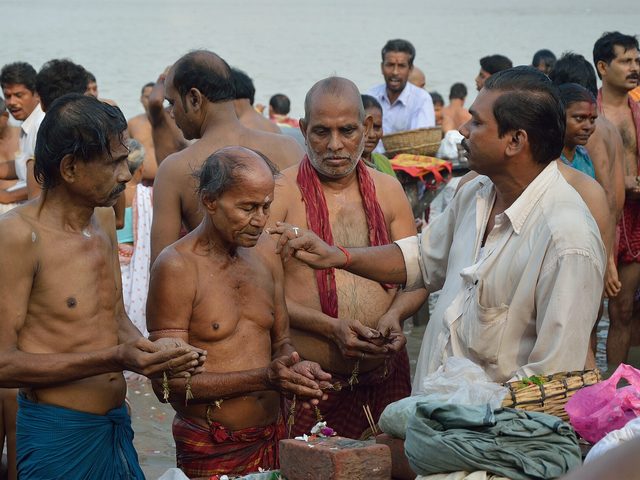
The ancestral rites are owed rather than chosen, and they are kept on the tithi of a death rather than on its calendar date — so a shraddh moves through the year. Tarpan, the offering of water with sesame, is the simplest and is kept daily through Pitru Paksha; the shraddh proper is annual; pind daan is kept at a tirtha and is held to discharge what the annual rite continues.
They are performed by the son or by whoever performed the last rites, fasting until the offering is made, and the register is quiet throughout — no aarti, nothing celebratory. Pitru Paksha, the dark fortnight of Ashwin, is when the rites are kept for the whole line rather than for one person, and Sarva Pitru Amavasya carries them for anyone whose tithi is unknown.
The practical difficulty is almost always the date. A family that does not know the tithi is not without recourse — the amavasya of the fortnight exists for exactly that — and a pandit will work it out from the calendar date if that is all there is.
The rites
Questions families ask
How soon can a pandit come?
Within a day in the cities we serve, and usually the same evening if you call. Say on the call that it is for ancestral rites and the request is handled first.
Can rites be performed if we cannot travel to Gaya?
Yes. Shraddh and Tarpan are kept at home anywhere. Pind Daan is traditionally kept at Gaya; families who cannot travel keep it at a local ghat with the same sankalp.
Who in the family should perform it?
Traditionally the eldest son, and in his absence any child or close relative. Pandits will guide you on the day; no one is turned away for not knowing.
What is included in the price?
The pandit’s dakshina, the vidhi and the samagri he carries. Ghat charges at Gaya or Varanasi, where they apply, are shown as their own line before payment.